Advertisement
Home Blog

At the helm of local revenue and relief
By Juliana Sridhar

0

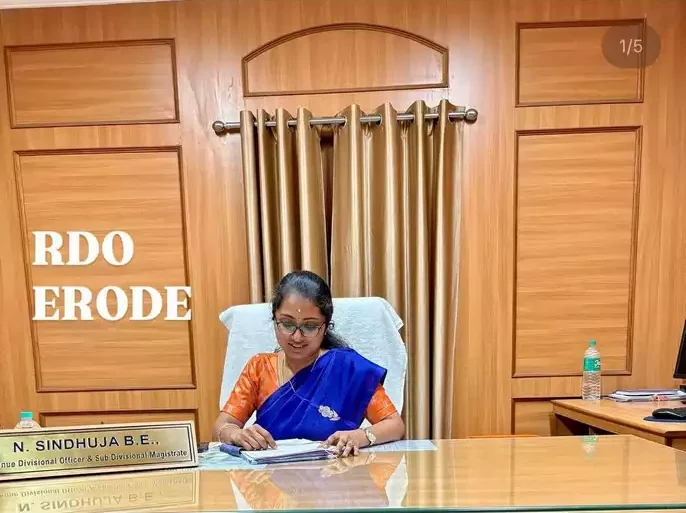
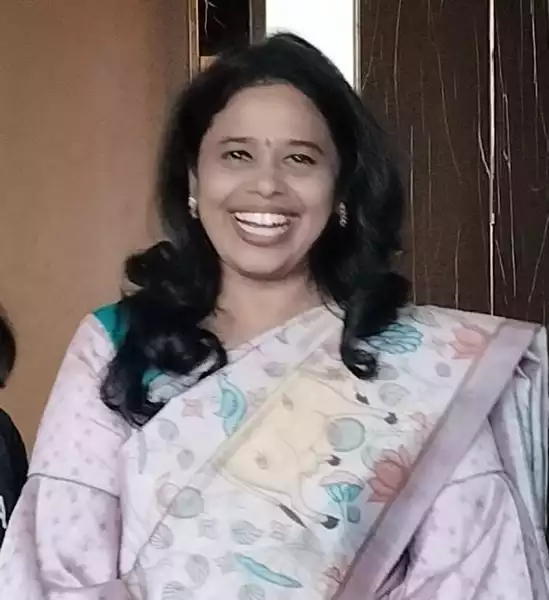
Meet N. Sindhuja, the young Revenue Divisional Officer & Sub Divisional Magistrate of Erode. This enterprising lady was born in Namakkal and brought up in Salem. Her Father Natarajan is an Inspector of Police while her mother Dhanalakshmi is a homemaker.

Sindhuja has one younger brother who studied MBBS in Stanley Medical College in Chennai and is now serving as a government doctor. 

She schooled at Jayarani Matriculation H.S. School in Salem till class X and completed her higher secondary education in Vetri Vikaas Girls Higher Secondary School in Salem. She followed it up with a BE degree in Electronics and Communication Engineering at the Kumaraguru College of Technology in Coimbatore.

Right from a young age, Sindhuja was fascinated with the civil services and her ambition was to become an IAS officer. She started preparing sincerely for the civil services exam since 2015.  She also wrote many other competitive exams. In 2017, she appeared for the TNPSC Group I examination. She fared extremely will and got selected in February 2019. She obtained 6th rank in the State in the exam.

Meanwhile, she also appeared for the BSRB exam and got selected by Union Bank of India where she worked for a short period.

After getting selected by the TNPSC, she quit the bank job and took up the post of Revenue Divisional Officer in Erode.

An RDO is vested with the powers of a District Collector. She also has exective magistrate powers as the post she occupies is also called as Sub Divisional Magistrate. Her job entails taking care of law and order, issuing patta, being a caretaker of revenue records, supervising ration shops and TASMAC, issuing community certificates to members of Scheduled Tribes.

She also has the powers of a revenue court and is empowered to register late births and deaths that are registered after a period of one year. 

As per the Senior Citizens Act, she has powers to grant maintenance to aged parents and even to cancel settlements done in favour of children if they neglect their aged parents. She is also invested with powers of land transfer, land acquisition etc.

Besides this, she is empowered to conduct an enquiry in dowry deaths if a woman dies within 7 years of marriage.

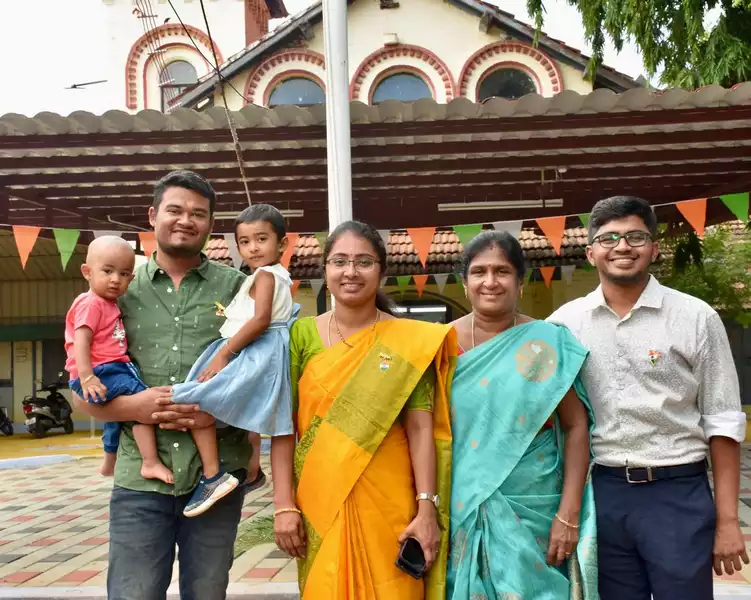
Sindhuja is married to a businessman Saran Kumar and the couple has  2 children- a 3 year old daughter Magizh Annya and a 1 year old son Hrithik Veera.

As her work keeps her on her toes, she hardly gets time to watch programmes on TV. If at all she gets to watch TV, it is the daily news.

She unwinds by doing gardening or by reading books whenever she gets that rare free moment.

She likes badminton and PV Sindhu is her favourite sportsperson. Her favourite colour is red and she prefers the traditional saree and salwar suit when it comes to outfits.

Sindhuja is hopeful to get IAS conferred on her shortly and when that happens, her dream of becoming an IAS officer will come true.

Juliana Sridhar is a lawyer and columnist

PM Modi lands in China for SCO summit

0

Prime Minister Narendra Modi arrived in China on Saturday August30, to attend the SCO summit. He earlier went on a two day visit to Japan.

During his visit to Japan, India and Japan, firmed up 15 key agreements and also announced the launch of several key initiatives.
Japan has set an investment target of 10 million yen (approximately 60,000 crore)  in India over a decade. PM Modi urged the Japanese government to forge stronger collaborations with India in manufacturing, mobility, next generation infrastructure, innovation, start-ups and small businesses.
During his two day visit to China, the PM will attend the annual summit of the ShanghaiCooperation Organization (SCO)  in Tianjin on August 31 and September 1.
PM Modi received a rousing welcome from the Indian diaspora on his arrival  in China’s Tianjin. A cultural performance was also staged for the PM.

A DESIGNER WITH A PASSION FOR COMMUNITY SERVICE
By Juliana Sridhar

0

Meet Preetha Mahesh, a multifaceted social entrepreneur and designer who has been doing exemplary service in the field of palliative care. She hails from a well known Kadathanad family from Kerala, now settled in Chennai. She was born to Padmanabhan and Padmaja. Her two siblings are Gayathri and Shree.

Preetha is married to Mahesh Kumar, an engineer who runs an interior designing company. Their 2 lovely children- Shivaani, a B Tech student and Vishak, a high school student, complete the family.

Armed with an MBA in Business Management, Preetha founded Soul Palliative Care in 2018, an initiative to provide compassionate care for people with serious illnesses. Palliative care is imperative for the alleviation of suffering by patients who face serious health issues and for improvement of their quality of life.

Preetha also manages an old age care centre for pensioners where training is offered in Android smartphone use as well as emergency medical care to empower the elders. Besides this, she runs a home for the visually impaired and focuses on imparting them with life skills so they can achieve financial independence.

Soul Palliative Care has provided palliative treatment and offered solace to more than 500 patients with life- threatening and life-limiting conditions, their families and caregivers till date.

The multidisciplinary team comprises palliative care nurses, doctors, physiotherapists and community volunteers across the districts of Chennai, Chengalpettu, Kanchipuram and Ranipet. (It includes Vandaloor, Urapakkam, Guduvanchery, Thirutheri, Thirukachur, Potheri, Singaperumalkoil, Thirukkazhugukundram and Poonthandalam regions).

Soul Palliative Care also provides home-based palliative care at the residence of patients and runs a 10 bed in-patient hospice facility in Medavakkam. This building was given to them by the Tamil Nadu government for taking care of terminally ill patients.

Their multidisciplinary homecare team, visit the patients and their families to provide them with necessary medical treatment and medicines and also offer financial support for specialized healthcare, physical rehabilitation and assistive devices.

Cots and wheel chairs are provided to all bedridden patients. Food kits are provided on a monthly basis to impoverished families and dependants of patients-eg children, senior citizens etc.

She runs a cloud kitchen in Kannagi Nagar called ‘’Aram Sei’’ where nutritious meals are prepared for the community at affordable prices.

She also heads a Vocational Training centre where young girls are trained in beautician courses, thereby equipping them with the necessary skills for employment.

Preetha’s passion for community service stems from her volunteer work in government hospitals in rural areas of Chennai and Chenglepet districts. It was there that she met her mentors Dr. Suresh IPM and Dr, Rajagopal of Pallium India and gained exposure and experience in palliative care.

World Health Organization defines Palliative care as ‘’an approach that improves the quality of life of patients (adults and children) and their families who face problems associated with a life-threatening illness. It prevents and alleviates suffering by recognizing, assessing and treating pain and other symptoms whether they are physical, psychosocial or spiritual.’’

Preetha’s mission is to reach out to people in pain and to those who suffer from diseases, to provide a good quality of life to the living, to provide dignity in death and basically to treat all people with empathy and compassion. Her goal is to prevent lack of awareness stand in the way of people accessing the care they require.

She envisions a future where anyone who suffers from serious health issues gets necessary care irrespective of their circumstances.

Some of her other activities include recruiting and training community members to manage patients with palliative care needs, liaising with treating hospitals/oncology institutes and medical colleges in the city to increase referrals to homecare and hospice by Soul Palliative Care, conducting workshops for health and allied health personnel, promoting awareness about palliative care needs through street plays and distribution of pamphlets in the local language.

Preetha unwinds by curling up with a book and never gets tired of learning new things. She is basically a very creative person being a designer by profession.

She learned the Bharatanatyam dance form for 16 years and loves performing on stage. She is fond nature and farming and likes to travel and explore new places.

She relishes all vegetarian dishes prepared in authentic Kerala style.

Her favourite outfit is the versatile saree and she prefers all shades of blue.

She is fond of Volleyball and is a state volleyball player.

Preetha likes to watch good family movies and is terrified of watching horror movies. Her favourite actors include Tom Hanks and Superstar Rajinikanth.

Through her diverse initiatives, Preetha exemplifies a deep commitment to social welfare and skill development. She dreams of empowering the community and making the world a better place.

Juliana Sridhar is a lawyer and columnist. 

Ronth and the Ramana Gaze: Lessons in Seeing Differently
By Justice N.Anand Venkatesh

0

In an age when our minds are locked onto screens, judging characters through filtered lenses and headlines, there comes a Malayalam movie like Ronth that gently forces us to pause, reflect, and confront the prejudices we didn’t even know we nursed. More than just a cinematic experience, Ronth is a layered exploration of humanity, told through the seemingly ordinary yet deeply profound journey of two policemen on a routine night patrol. But what begins as another chapter in law enforcement unfolds into a story that quietly dismantles the very foundations of societal judgment.

From the opening frame, where shadows stretch long and reality breathes heavy, the film grips not because of melodrama, but because of its stark honesty. These are not superheroes chasing grandeur, nor villains lurking in disguise. They are just two human beings tasked with holding up fragile threads of order, while battling their own unknowns. As they traverse dimly lit streets and face the unpredictability of the night, we are walked through their inner corridors too – their vulnerabilities, conflicts, and moral dilemmas. Every seemingly mundane slab of duty becomes a mirror reflecting deeper truths. And suddenly, the uniform blurs, revealing the person behind the badge.

Isn’t that what we have long forgotten to do, see the person behind the label?

“I stopped explaining myself when I realized people only understand from their level of perception,” said Jim Carrey once. That perception, sadly, is often shaped not by empathy or understanding, but by prejudice, rumor, or a viral clip. Particularly when it comes to figures of authority, like police officers, we tend to reduce them into caricatures , either corrupt power-mongers or symbols of control. But how often do we sit down and ask: What does a night in his shoes feel like? What toll does it take on someone to witness the darkest corners of humanity and still return home to hold their child?

The same judgment seeps into all spheres of our lives. We consume art, music, performances, achievements — everything through an invisible lens, always calibrated to calculate not only talent, but morality. A music composer moves us to tears with his melodies, yet online chatter compels us to measure his personal character. A sportsperson’s performance, once jaw-dropping, suddenly falls under shadow because of an old controversy. A brilliant actor delivers a performance of a lifetime, and still, the dialogue drifts towards their private choices.

What fragile pedestal are we building, expecting humans to be infallible while hungering for their excellence? A striking metaphor plays out in a memory that surfaced while watching Ronth. Once, in the serene Ashram of Tiruvannamalai, a man known for his misdeeds entered wearing a sparkling white shirt. His presence unsettled many. One devotee, unable to contain his discontent, approached Saint Ramana and questioned how such a man could be allowed into such a sacred space. Ramana simply looked at the man and replied, “See how clean and sparkling his white shirt is.” Not a sermon. Not a judgment. Just a gentle nudge to see and truly see what we often ignore.

That one moment holds within it an ocean of insight. Because Ramana did not deny the man’s past and. he just chose to focus on something else. He chose to highlight the visible cleanliness, as a metaphor perhaps, for the potential of goodness in anyone and a possibility waiting to be noticed, even if buried under layers of mistakes. Isn’t that the grace we often extend to ourselves but rarely offer to others?

May be it’s time to stop mixing the art with the artist unless their actions harm the very humanity their work represents. Maybe it is time to stop expecting our role models to be spotless saints and understand that brilliance and human imperfection can coexist. The real betrayal is not their flaws. It is our hypocrisy. When we admire a music composer for his genius yet cancel him for a personal failing that may have little to do with his art, what are we really doing? When we dismiss the courage or grit of a law enforcer because we carry an ingrained notion and are we being any better than the thing we claim to hate?

As Ronth portrays with haunting realism, life does not present clear heroes or villains. It merely offers choices, decisions, and moments that shape perceptions. And within every uniform, every artist, every person — lives a story, often far more complicated than our simplified summaries. And maybe it is time we start applying this not just to ourselves, but to those we so quickly judge. Maybe the dignity we seek from the world is the same we ought to offer others, regardless of who they are or what the world says they have done.

In the end, goodness is not in perfection. It is in perspective. Perhaps the more important question to ask isn’t about others, but ourselves “What are we choosing to see in people?”.

Sometimes, it’s enough to just notice the sparkling white shirt.

Justice N.Anand Venkatesh Judge Madras High Court

A VISIONARY ACADEMICIAN
By Juliana Sridhar

0

Dr. Bhanu Rekha, a visionary academician who blends sustainability, innovation and design in fashion technology education was born in Coimbatore to IT Officer Vivekanandam and Vasantha Bai who worked for the Survey Department of the Collectorate.

She schooled at St. Joseph’s Matriculation School in Coimbatore and did her B.Sc in Interior Designing and Environment and Psychology at the Avinashilingam University. She later pursued a PG Diploma in Dress Making and also completed a PG Diploma in Computer Science in NIIT.

Her marriage was arranged with Dr.P. Ramesh at this juncture. She continued her education after marriage and completed M.Sc in Textiles and Clothing. After completing her post graduation, she worked in the same college for a couple of years before moving on to Kumaraguru College of Technology in 1999. It was the first college in India to offer B.Tech in Fashion Technology. This college is affiliated to Anna University.

Bhanu Rekha says that even though NIFT started earlier, they only had a diploma course in Fashion Technology and only later converted it to BF Tech.

She worked here for around 19 years and completed her PhD in Fashion Technology. The topic she chose was the woman centric, eco-friendly sanitary napkins. 

She shifted to Chennai in 2018 with her family and joined the Fashion and Technology Department of KCG College of Technology where she used her expertise to assist in establishing the whole department. 

When she plans the curricular and co-curricular activities for her students, she learns along with them. She believes in empowering her students to design with purpose and to lead them with innovation.

After a stint of 7 years, she recently joined SRM University at Ramapuram. 

Dr. Bhanu Rekha has over 26 years of academic and entrepreneurial experience and she is dedicated in shaping the next generation of fashion professionals.

She has done extensive research and explored functional and eco-friendly textiles especially in the areas of absorbent hygiene products, non woven textiles and smart wearables.

She has received awards for many of her projects including the Best Project award for the students project ‘’Brand analysis and evaluation of men’s shirts for retail market’’ in 2007-2008 and the best project award for the students project ‘’Design and Development of sweat protective lingerie for silk blouses in 2009-2010.

She was recently conferred the Excellence in Education Award 2025 by Masters Professional Academy, Coimbatore.

Dr. Bhanu Rekha has organized numerous workshops, guest lectures, conferences, webinars, panel discussions, seminars, fashion shows as well as mock interviews for the students.

Besides this she has many publications to her credit both in National and International publications.

To unleash her creative streak, she does craft and embroidery during her free time.

She learnt to play the Veena and is also a trained singer and dancer who gave stage performances earlier but after marriage, her family and career took up her whole time.

Her only daughter Gopikashree is currently pursuing B.Tech in ECE in VIT Chennai.

After a long day at work, she unwinds by watching serials on Television with her husband. She enjoys watching movies and listening to podcasts and finds it thrilling to watch IPL matches on TV with her family.

Her taste in food is very simple and she relishes chapathi with a side dish and the humble curd rice.

Her favourite colours are shades of blue and green especially teal and peacock green.

Dr. Bhanu Rekha’s work extends beyond the classroom. She is instrumental in shaping the future of the fashion industry by nurturing a generation of designers and entrepreneurs who will be well equipped to address the present day challenges and translate their artistic ideas into tangible garments that meet both aesthetic and functional requirements.

Juliana Sridhar is a lawyer and columnist

BEYOND THE PULPIT
By Juliana Sridhar

0

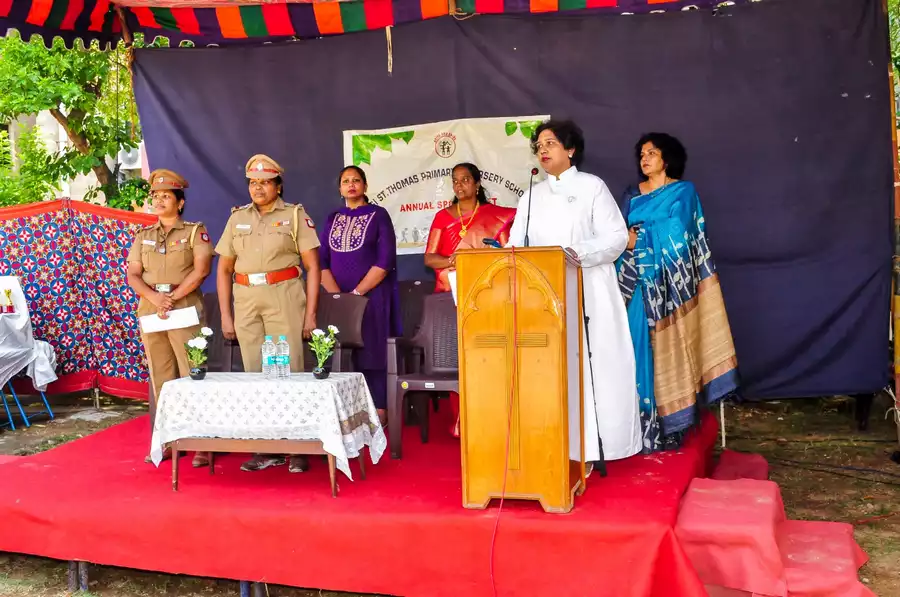
Rev Anitha Christian who is the Presbyter at CSI St. Thomas English Church in Santhome is personally committed to serving God. She is one of the few women presbyters in the city. Women have always played key role in the Christian missions, in spaces like education and medicine, founding and developing institutions and communities for many years, now the church has carved path for women to be ordained to lead and partner in the ministries of the church independantly.

This historic, sparkling white church is one of the oldest Anglican churches and was built in the year 1842.  Rev. Robert Carver was instrumental in building the church. It was named in honour of St. Thomas, an apostle of Christ who was martyred and buried in this area. It became a part of the Church of South India, Diocese of Madras in 1947. It was once known as ‘St. Thomas-by-the-Sea’.

The church is just a few metres away from the Santhome Basilica. It has around 500 members and is surrounded by apartment complexes. It is actively involved in outreach programs, including sponsoring children and supporting missionaries. It supports the Diocese in building churches and schools in rural areas.

The church has a school located within its campus. CSI St. Thomas Nursery and Primary School was started in the year 1985. It offers quality education to children belonging to the marginalized sections of society. The school is run by CSI St. Thomas English Church with the approval of CSI Diocese of Madras. The aim of the school is to improve the quality of life by meeting both the academic and social needs of the students, to instill right values and good habits in them and to inspire their minds.

The school endeavours to impart quality education to the students through trained and dedicated teachers. The Correspondent of the school is Rev Augustin Premraj, while the Convenor and Treasurer is Mrs. Gemina Martin. The headmistress of the school is Mrs. Annalakshmi. Children studying here, love this space as they connect, develop a community and feel belonged in all ways. Events conducted in the school display the pride and passion of both the teaching and learning partners of the school.

The school has grown in strength and currently nurtures 205 students. In its journey of 40 years, they are continuing to strive for greater success and foster a culture of innovation, discipline and holistic development.

Juliana Sridhar is a lawyer and columnist

When the Divine Seeks: The Prophet’s Enduring Example
By Justice N.Anand Venkatesh

0

There is a timeless saying in spiritual traditions that you do not search for a guru; when you are truly ready, the guru finds you. This idea, at first, seems paradoxical. Human nature is restless, always seeking answers, striving to reach the divine or the higher power, whatever name one gives it. Yet, the wisdom of the ages suggests that the ultimate encounter is not a result of relentless searching, but of readiness—a state of inner preparation where the seeker becomes the sought. The metaphor of the prey caught in the mouth of a tiger is striking. Once the guru, or the divine, claims you, escape is impossible; your life is transformed forever.

This leads to a profound question: if it is not man who finds God, but God who finds man, then whom does God choose? What makes a person worthy of such a calling? The life of Prophet Muhammad offers a powerful answer to this question. His story is not just one of spiritual revelation, but of unwavering integrity, trustworthiness, and a character so pure that even those closest to him, and those most opposed to him, could not find fault with his honesty.

Before he became a prophet, Muhammad was known throughout Mecca as Al-Amin—the trustworthy. People from all walks of life, including the wealthy and the influential, entrusted him with their possessions. His reputation was such that even his enemies would leave their valuables in his care, confident that he would never betray their trust. His wife, Khadijah, a successful businesswoman, not only trusted him with her business but ultimately with her life. This level of trust is rare, especially when it comes from those who know you intimately. Usually, those who see us up close, who witness our flaws and weaknesses, are the first to point out our shortcomings. Yet, in Muhammad’s case, even those closest to him could only attest to his honesty and uprightness.

There is another group whose opinion is even harder to win: one’s enemies. An enemy, by definition, seeks to undermine and discredit. They look for the smallest crack in your character to exploit. Yet, even Muhammad’s staunchest opponents could not accuse him of dishonesty or betrayal. They might have disagreed with his message, even fought against it, but they never doubted his integrity. This is a rare phenomenon in human history. Most great figures have detractors who question their motives or actions, but the Prophet’s moral stature was so unassailable that even his adversaries acknowledged it.

When Muhammad received the first revelation at the age of forty, it was not an accident or a random event. It was the culmination of a life lived in truthfulness, humility, and service. The divine message came to a vessel that was already refined, already prepared. When he shared his experience with the people of Mecca, their immediate reaction was not skepticism, but trust. There is a famous incident where he called the people to the hilltop and asked if they would believe him if he said that enemies were approaching. Without hesitation, they replied that they would believe him, for he had never lied to them. This level of credibility is not built overnight; it is the result of decades of consistent, principled living.

Even at the most critical juncture, when his life was in danger and he was about to leave Mecca for Medina, Muhammad refused to leave hastily. He insisted on returning all the possessions entrusted to him, despite the fact that many of their owners were now his enemies. On the very night he was to leave Mecca, rather than depart in haste, he instructed his cousin Ali to stay behind and return every single item that had been left with him for safekeeping, ensuring that not a single trust was betrayed even for those who sought his harm. This act was not just a gesture of honesty, but a profound declaration that true character is measured not by convenience or circumstance, but by steadfast adherence to principle. It is in such moments, when integrity is tested under fire, that the worthiness of a soul is revealed and the reason for divine selection becomes clear. This act alone speaks volumes about his sense of responsibility and his unwavering commitment to justice. He did not let personal danger or animosity cloud his moral judgment.

The lesson here is profound. The divine does not choose arbitrarily. The ones who are chosen are those who have demonstrated, through their actions and character, that they are worthy vessels for a higher purpose. It is not about outward rituals or displays of piety, but about the inner quality of truthfulness, trustworthiness, and selfless service. The life of Prophet Muhammad shows that when a person embodies these qualities, the divine finds them, just as the guru finds the prepared disciple.

In a world where cynicism is rampant and trust is in short supply, the story of Muhammad’s life is a reminder that true greatness is rooted in character. The respect he commanded was not due to wealth, power, or lineage, but because he lived by principles that transcended personal gain. Even those who opposed his message could not deny his honesty. This is the ultimate testament to the power of integrity.

There is also a subtle message about the nature of spiritual readiness. It is not about seeking extraordinary experiences or chasing after the mystical. It is about living each day with sincerity, fulfilling one’s responsibilities, and treating others with fairness and compassion. When these qualities become second nature, the higher power, or God, recognizes the readiness of the individual and bestows upon them a greater role.

The metaphor of the prey and the tiger captures the irreversible nature of this encounter. Once the divine claims you, your life is no longer your own. You are carried along a path that you did not choose, but for which you have been prepared. The transformation is total, and there is no turning back.

In reflecting on the life of Prophet Muhammad, one sees a blueprint for spiritual preparedness. It is not about withdrawing from the world, but about engaging with it fully, with honesty and integrity. It is about being trustworthy in small things, so that when the moment of destiny arrives, you are ready for the larger task. The divine chooses those who have already chosen the path of truth, often long before they realize it themselves.

Ultimately, the story of the Prophet is not just a chapter in religious history, but a universal lesson. It challenges each of us to ask: are we living in such a way that, if the higher power were to seek a messenger, we could be chosen? Are we trustworthy, not just in the eyes of strangers, but in the eyes of those who know us best and even in the eyes of our enemies? The answer to whom God chooses lies not in mystery, but in the quiet, consistent practice of integrity and truthfulness, day after day, year after year.

Justice N.Anand Venkatesh Judge High Court Madras

AN AUTISM AMBASSADOR
By Juliana Sridhar

0

Vanishree Venugopal, a core group member of the forum for autism in Mumbai, was born and brought up in Chennai. Her father Subramanian worked for a private firm while her mother Kamakshi is a homemaker. She has an elder sister Rajashree.

As her family lived in Royapuram, it was only natural that Vani schooled at St. Kevins Anglo Indian Higher Secondary School. She completed her higher secondary education in St. Columbans Anglo Indian Higher Secondary School and joined Bharathi Women’s College where she pursued BSc in Physics.

After completing her education, she worked in a private concern.  Marriage to Venugopal from the IT sector, took her to Mumbai. Life was moving smoothly for Vani till her only daughter Pushkalaa was diagnosed with autism at the age of 18 months. Though she wanted to take up a job, she had to sacrifice her career to take care of her daughter and soon became adept at multi tasking.

She enrolled Pushkalaa in a special school and had to travel long distances after school to different therapy centres. Vani took up a job in the same school where she gained hands on experience on how to handle special children. She used these same techniques at home to take care of her daughter.

Due to Pushkalaa’s erratic sleep cycle, Vani has to stay up late nights and at times sleep only in the wee hours of the morning. 

Vani is an autism ambassador and is part of autism awareness groups where she tries to spread acceptance, awareness and inclusion of the neurodivergent through story telling on many social media platforms. She is grateful to Spectrum, the Awareness Project team for including her in it.

Her love for writing blogs, short stories and poems made her become a member of the Maharashtra Tamil writer’s association where she is a regular contributor. Her short story in Tamil was published in the 25th anniversary souvenir of the association in 2024. She is a regular program host, singer and speaker in this association. She also shares her poems and short stories on various social media platforms.

Vani also likes to sing and she joined the Mumbai Tamizh Sangam. Here, she found a medium to unleash her creativity. She sings, speaks and even takes part in rangoli competitions held at the Sangam. To improvise her singing skills, she tried out apps like smule and slowly moved on to professional singing and got to perform on various platforms.

Her ‘ME’ time is spent doing drawing and painting and Vani realized that it helps her to relax and cope better. 

With her husband’s support, she started a small catering unit during the Covid-19 period and whipped up simple meals to cater to senior citizens in the neighbourhood. This later on became a regular source of income.

Nowadays, she also takes up catering orders for birthday parties where she supplies authentic South Indian dishes like idli sambar, masala dosa, vada, poori potato etc. These food items are a big hit with the Mumbai crowd as the taste is very different from the local cuisine.

Cooking is another passion of hers and she loves to try out new, healthy recipes. Her daughter is on Ayurvedic medicine hence there are a lot of food restrictions for her. Hence Vani is always experimenting with new recipes and gets to prepare simple and nutritious vegetarian food.

Being a positive and optimistic person who takes life in its stride, she tries out her hand at many things. For instance, she conducts games for birthday parties, kitty parties and even for wedding events.

Gardening is another hobby of hers and she maintains a small kitchen garden in her ground floor flat.

She makes it a point to go for evening walks or visit temples along with her daughter. Though she does not go to theatres to watch movies, she watches TV serials and listens to music. In fact her daughter too likes listening to music.

Though raising an autistic daughter presents unique challenges for Vani, she has coped well. Her positive attitude and effective parenting techniques have made a big difference.

Juliana Sridhar is a lawyer and columnist

When Words Returned Humanity Rediscovered Its Wonder
By Justice N.Anand Venkatesh

0

What if, one morning, you woke up and found that language was gone? Not just your own language, but all words everywhere—no way to speak, write, or even whisper your thoughts. The world would still be there: trees, birds, the sun rising. But you couldn’t share your dreams, your worries, or even warn someone about a banana peel on the floor. (Though, let’s be honest, some people might still slip for our silent amusement.)

Without language, the past would be a mystery. The wisdom of old books and poems—gone. No Tirukkural, no Shakespeare, no bedtime stories, no secrets shared at midnight. Imagine loving someone but never being able to say “I love you.” Imagine losing someone and not having the words to say “I miss you.” Imagine a world where you can’t even tell a joke. Would we still laugh, or would laughter feel empty without a reason?

Words are curious things—simple sounds or marks on a page—yet they transcend time, carrying the weight of ancient dreams and fresh hopes. A word written centuries ago can reach across ages and stir our hearts as if spoken this very moment. Consider the profound truth from the Gospel of John: “In the beginning was the Word, and the Word was with God, and the Word was God.”

What a wonder that is—that words are not just tools, but something divine, the very essence of creation itself. Words are our closest glimpse of real magic. Whisper “freedom,” and hearts soar; say “home,” and warmth spreads through the room. Words can wound deeply, yet they hold the power to heal. They open doors between strangers or quietly close them. In every way, words shape the world we share, weaving the fabric of our lives and connecting us across time and space.

But what if we never had words? Would we still be curious? Would we wonder about the world, or just focus on surviving—finding food, staying safe, sleeping at night? It’s questions that make us human, and language helps us ask them. Without words, would our curiosity just be a quiet ache, something we feel but can’t explain?

Maybe we will find new ways to reach each other—a glance could become a poem, a wave of the hand a melody. Perhaps we’d learn to read whole stories in a single look, or sense joy and sorrow in the smallest gesture. Yet, would that ever truly fill the space left by words? Could a hug or a smile ever capture the thrill of sharing a secret, the weight of a promise, or the wonder of telling a dream? Something precious might always remain just out of reach, waiting for words to set it free.

Sometimes I wonder if words choose us as much as we choose them. The poet who wrote the Tirukkural never told us his name, but his words have lasted for centuries. That’s the power of language: it lets us send messages to the future, lets us become more than just our bodies. Still, words can be tricky. Sometimes we say the wrong thing, or can’t find the right words. Sometimes we hide behind language, or use it to hurt. Maybe, in a world without words, we’d have to really look at each other, to really feel. Maybe we’d lose poetry, but gain honesty. Or maybe we’d just be lonely—each of us an island, unable to reach out.

Now, imagine a day without words—a simple breakfast turns into a comedy. You want your sibling to pass the salt, so you point, wave, and make wild shaking motions. They stare at you, confused, and hand you the pepper instead. You try again, this time miming a waterfall, hoping they’ will get “salt.” Instead, they hand you a glass of water. Soon, everyone at the table is waving, pointing, and making faces, and the dog is the only one who understands what is going on. Breakfast becomes a silent movie, full of laughter, mistakes, and wild gestures—funny, yes, but also a little frustrating. All it would take to fix the mess is a single word.

I would rather live in a world with words. I would rather risk being misunderstood than never be understood at all. I would rather try to say what I feel, even if it is hard, than be silent forever. Words are the footprints we leave behind, proof that we were here, that we loved, that we wondered, that we tried.

So next time you speak, write, or even think, remember: you’re using the oldest and greatest magic. You’re reaching out, hoping someone will understand. And that, more than anything, is what makes us human.

Justice N.Anand Venkatesh Judge Madras High Court

The Quiet Power of Writing
By Justice N.Anand Venkatesh

0

Lately, I have noticed something new in myself: I am writing more than ever before. Every time a powerful thought or feeling strikes, I feel a strong urge to put it down, to shape and colour it with words. Sometimes it is just a sentence or a paragraph, but often it grows into a page, an article, or even a poem. I wonder Why is this happening? What is it about writing that draws me in so deeply? Is it just a habit, or is there something more profound at work here?

Life has a funny way of answering our questions, often when we least expect it. Just as I started to question this new habit, a young intern walked into my chamber and handed me a book: The Power of Writing It Down by Allison Fallon. It felt like a gentle nudge from the universe, as if to say, “Here, read this. You might find some answers.” And indeed, I did. Fallon writes about how even a few minutes of writing each day can change our lives. She explains that writing helps us process our emotions, clear our minds, heal old wounds, and break free from patterns that hold us back. She says it’s not about being a great writer, but about the act itself. Writing is a journey inward, a way to discover who we really are.

This made me pause and reflect. Why do I write? Is it to impress others, to be heard, or is it something I do just for myself? I realized that writing gives me solace. When life feels heavy, when worries pile up and the world seems too much, putting my thoughts on paper lightens the load. When I am happy, when joy fills my heart, writing helps me savor the feeling, to hold onto it a little longer. And sometimes, when I share my words, I find that others have felt the same way but never said it out loud. Writing connects me to people in a quiet, powerful way, reminding me that I am not alone.

But there is more to it than just connection or comfort. I started to wonder: What will happen if I keep writing? What will I see when I look back at my words ten years from now? Will I recognize the person who wrote them? Will I see how much I have changed, how far I have come? Writing, I realized, is like planting seeds for my future self. It is a way to track my own growth, to see my thoughts evolve, to witness my own transformation. Why do any of us write? Is it just to remember, or is it to understand ourselves better? Is it to leave something behind, or to make sense of the present? Maybe it is all of these things. Writing is a mirror. It shows us who we are, who we were, and who we might become.

In a world that moves so fast, where everything seems to happen in an instant, writing is a pause. It is a moment of stillness, a chance to listen to our own hearts. It helps us untangle the mess inside, find clarity, and plant new dreams. Writing is not about perfection or praise. It is about honesty, about being present with ourselves.

Sometimes my thoughts are tangled like a ball of yarn, and writing helps me pull at the threads, one by one, until I find the end. Sometimes, I don’t find it right away, but the act of trying brings me peace. Other times, I write simply to remember—to capture a moment, a feeling, a thought that might otherwise slip away.

And then there is the magic of connection. The words I write today might touch someone tomorrow, or even years later. My words might become a bridge to someone else’s heart, a reminder that we are not alone. Writing is a gift to ourselves and to others. I remember once sharing an article I wrote about judicial loneliness. A friend read it and said, “I felt the same way, but I never knew how to say it.” That moment made me realize the power of words. They can heal, inspire, and connect us in ways we never imagined. Writing is not just for writers. It is for everyone. You don’t need to be a poet or a novelist. You just need to be honest with yourself, willing to sit down and let your thoughts flow.

So, I ask myself again: Why do I write? I write to find myself. I write to heal, to grow, to connect. I write to leave a trail of thoughts for my future self to follow. I write because it brings me peace, and sometimes, it brings others peace too. Writing is a journey inward. It is a way to explore the landscape of your own mind.

Sometimes, you will find joy. Other times, you will find pain. But always, you will find yourself. Writing is like looking in a mirror and seeing your true reflection, not the one you show to the world, but the one you keep inside. When I write, I am not always sure what will come out. Sometimes, I am surprised by my own words. Sometimes, I discover feelings I didn’t know I had. Writing helps me make sense of the world and my place in it.

To anyone wondering if they should write, I say: Start small. Write for yourself. Let your words flow without fear or judgment. You might be surprised at what you discover. You don’t need to write a novel. You can write a sentence, a paragraph, or just a list of thoughts. The important thing is to start. The more you write, the easier it becomes. The more you write, the more you will understand yourself. I have started to make writing a daily practice. Even on busy days, I try to write a few lines. Sometimes, it is just a note to myself. Other times, it is a message to my WhatsApp group. The act of writing, no matter how small, helps me stay grounded.

Writing is not about being perfect. It is about being present. It is about showing up for yourself, every day, one word at a time. In the end, writing is a journey—a journey inward, a journey home. And that, I believe, is its true power. Looking back at my writings, I see the struggles, the joys, the fears, and the hopes. I see my journey, written in my own words. Sometimes, I laugh at my old self. Other times, I am moved by my own words. But always, I am grateful for the gift of reflection. Writing is a way to honor your past, embrace your present, and dream about your future. It is a way to celebrate your life, in all its messy, beautiful glory.

Everyone has a thought or a message to convey. It is unique for each of us and is yours alone. Writing is a way to tell your story, to share your truth, to make sense of your life. Your story matters. Your words matter. I wonder what my writing will look like in ten years. Will I still write every day? Will my words change? Will I see the world differently? I don’t know the answers, but I am excited to find out.

Writing is a journey, and I am grateful to be on it.

So, to anyone reading this, I invite you to write. Start today. Start small. Write for yourself. Let your words flow. You might be surprised at what you discover. Writing is not about perfection. It is about presence. It is about showing up for yourself, one word at a time. In the end, writing is a journey—a journey inward, a journey home. And that, I believe, is its true power.

Justice N.Anand Venkatesh Judge High Court Madras


 

Beyond Sight: A Professor’s Journey of Teaching and Inspiration
By Juliana Sridhar

0

Dr. Hemachandran Karah was born and raised in Chennai. His father Srinivasan was an employee of Tamil Nadu Electricity Board while his mother worked for a cooperative society. He has only one sibling a younger sister named Sumathi.

His formative years were spent at Little Flower School where he did his schooling in Tamil medium and later shifted to St. Louis School for the blind in Adyar. He completed his higher secondary education at MCTM, Purasawalkam.

Due to his visual impairment, he was unable to read books and study by himself, so he sought the help of his friends and his parents. There were volunteers in school who were of great help to him.

His college education was initially done in Loyola College where he pursued B.A. in English Literature. He followed it up with a Master’s degree in Literature at Hyderabad University. He got a lot of exposure over here as he lived with friends in a residential hostel in Central University campus. Here, either his classmates used to read for him or he used to visit the home of a reader Ranjani. There was a Readers Association for the blind that comprised of mostly women, especially home makers who used to read out lessons for the visually impaired students.

He returned to Chennai to do M.Phil at the Madras University. While studying here, he took up assignments like writing reports for newspapers etc.
As Hemachandran had his heart set on academics, he was interested in further studies. Lady luck smiled on him and he secured a scholarship at the Cambridge University in England. He pursued PhD there, but it took him 6 years to complete as he faced a lot of health issues during this period.

Though living in England was a great experience for him, he had to live alone in the college hostel. He found it challenging but he was lucky to get a great supervisor who supported him in his endeavours. As he found it hard to get people to read for him there, he learned how to use the computer and became adept at it. 

After completing his doctorate degree, Dr. Hemachandran returned to his motherland to contribute to society. For a short stint, he went to Delhi where he taught at St. Stephens College and also worked as a research fellow.

He applied for teaching jobs in Chennai and got selected by IIT, Madras to teach English Literature as well as Disability Studies. He is now an Associate Professor at the Department of Humanities and Social Sciences in IIT, Madras.

Dr. Hemachandran has published a number of peer reviewed essays in academic portals and books. He also co-edits the global section of the journal Review of Disability Studies.

Last year, he founded an Accessibility Research Centre (ARC) that is funded by CSR and is a principle investigator here. Dr. Hemachandran along with his fellow co-investigators from IIT Madras, gather high quality teacher tutorials on the theme disabilities and disciplines.

He is a recipient of a fellowship grant from the Indian Foundation for Arts. With this grant, he pursued a collaborative research project on the theme of theological accessibility.

Dr. Hemachandran was one of the principal investigators of a global project on Covid and mental health organized by Ohio State University.

He is now busy with a book on Disability Studies that he is co-authoring with a colleague Shilpa Anand. The book will be released shortly.

Being a friendly person, he enjoys conversing with students and they help him to fine tune his expertise in disability studies, literary criticism as well as comparative musicology. His work involves 8 hours of teaching per week, guiding Phd students and research work.

Plans are on to conduct a Faculty Development Programme for school teachers and NGO’s. Their ideas and recommendations will be taken on how to build and expand Space Science and measures to make higher education easier for students with disabilities.

He is also involved in conducting Sound Sculpting competitions for school children. He has plans to include Inclusive Schools and Universities too. According to him, it is a fabulous experience and competitions are slated to be held later this year.

Apart from his work that keeps him busy throughout the day, he plays the violin especially Western Music during his free time and enjoys it a lot. He appreciates comedy and derives a lot of happiness talking with friends and family.

Despite being a visually impaired professor, Dr. Hemachandran has been achieving laurels and professional milestones. He has proved that a person’s disability does not limit one’s potential for success.

Juliana Sridhar is a lawyer and columnist

Chennai born professor is the first Indian -American to be appointed to MIT

0

Anantha Chandrakasan, a Chennai born professor has been named as the next provost of the Massachusetts Institute of Technology (MIT). He is the first Indian-American to be appointed to this key position at the prestigious US institution.

He will take charge of the post on July 1. Chandrakasan is currently the chief innovation and strategy officer and dean of engineering in the MIT Many candidates were competing for the post but Chandrakasan was selected. MIT President Sally Kombluth praised his work
Chandrakasan said that he was deeply honoured to take over the role of provost. The provost is the chief academic and budget officer of MIT who will oversee academic programs, faculty affairs, strategic planning and will also lead a team of vice provosts who will be responsible for areas ranging from  arts to international engagement.
He will succeed Cynthia Barnhart who will be stepping down from the post.

93 year man buys mangalsutra for his wife for just Rs 20

0

A 93 year old man from Maharashtra dressed in a traditional white dhoti and kurta, walked into a jewellery shop accompanied by his wife in Chhatrapati Sambhajinagar to buy her a mangalsutra.

The shop owner was overwhelmed with the gesture of the elderly man and he gave him the mangalsutra for a token amount of Rs 20.
A video of this heartwarming moment has gone viral on social media platforms and it has garnered more than 2 crore views and many netizens were impressed with the love that the elderly man had for his wife.
Nivrutti Shinde and his wife Shantabai, hail from a humble farming family at Ambhora Jahangir village in Jalna district. They are right now on a pilgrimage to Pandharpur on foot for the Ashadhi Ekadashi celebration.
The couple had only Rs 1,120 with them and wanted to buy the mangalsutra with this money but the shop owner took only Rs 20 from them and returned the balance amount.

Rishi Sunak and Akshata Murty return to Stanford after 20 years

0

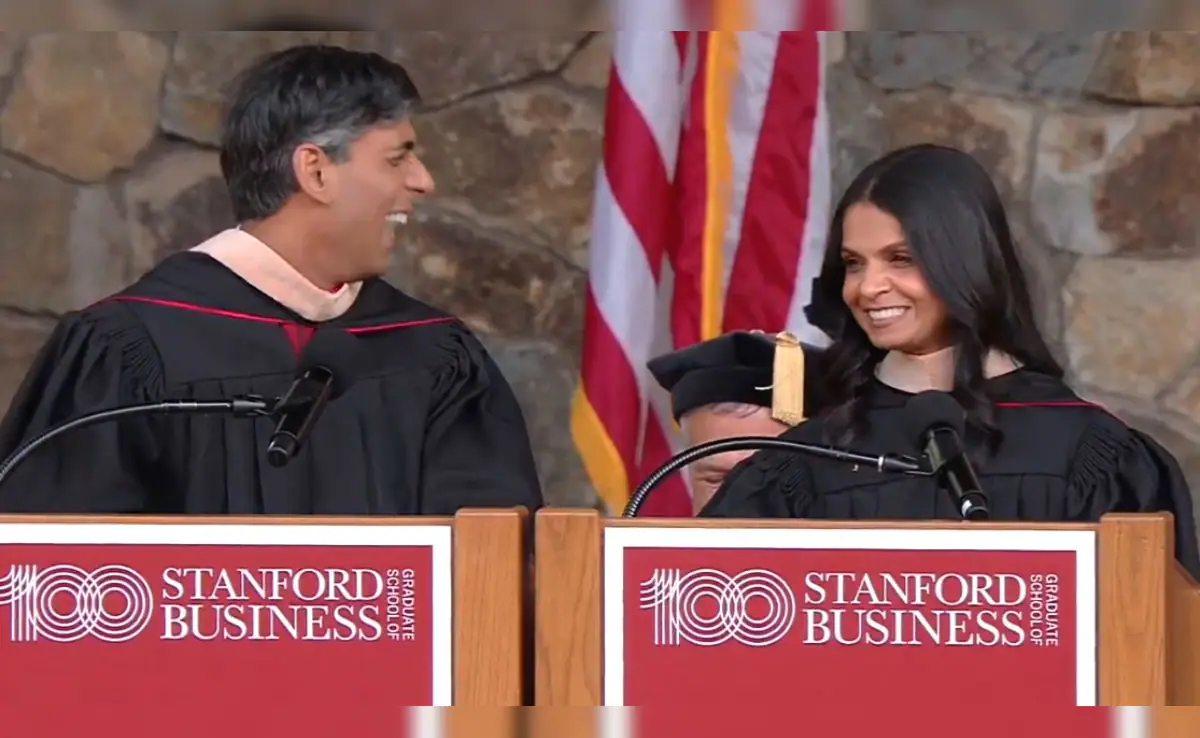
Former UK Prime Minister Rishi Sunak and his wife Akshata Murty studied at Stanford. They were MBA students when they met each other and later got married in 2009.

Two decades after they met and fell in love on the campus, Rishi Sunak and his wife Akshata Murty returned to Stanford Graduate School of Business, not as students but as commencement speakers for the Class of 2025.
Akshata Murty is an investor and philanthropist and the daughter of Indian industrialist Narayana Murthy. She became emotional when she visited the Business School as she recalled the place where they exactly met. She also remembered her journey from India to California and she referred to Stanford as ”nothing short of transformational”.
During her speech, she shared some memories of their student days. The couple later shared three key life lessons that they learned along the way.
Rishi Sunak ended his speech with a tribute to their relationship and said that they have always pushed each other’s thinking to become sharper.

Chef Vijay Kumar from Tamil Nadu wins James Beard award

0

Chef Vijay Kumar of Semma made history as the Tamil Nadu born chef who won the Best Chef award at the James Beard Awards in New York State.

Chefs and restaurants were honoured with James Beard Awards, one of the US culinary community’s highest accolades. For the first time, an Indian restaurant has taken the top spot.
Vijay Kumar of Semma, the Greenwich Village hotspot that serves South Indian food has been named as the Best Chef by the James Beard Foundation that is considered to be the Oscars of the food world.
Semma was opened in 2021 and helmed by Chintan Pandya and Roni Mazumdar. This restaurant has redefined what Indian food looks like on fine dining menus.
Besides this award, the restaurant has also got the No1 spot on the New York Times 100 Best Restaurants list and is the only Indian restaurant in New York City currently holding a Michelm star for three consecutive years.
Chef Vijay Kumar accepted the award dressed in a veshti and said that he never thought he would get such a prestigious award when he started cooking.

Al Pacino is the first actor to meet newly elected Pope Leo XIV at the Vatican

0

Veteran Hollywood movie star Al Pacino was the first actor to get to meet the newly elected Pope Leo XIV at the Vatican. He was accompanied by producer Andrea Iervolino.

Cardinal Robert Francis Prevost was elected as the new Pope by cardinals at the papal conclave held last month.
This meeting between the newly elected Pope and the veteran actor was a moment of profound spiritual as well as cultural inspiration.
According to a statement by producer Andrea , the visit was made in cue for a private audience for the delegation from the film Maserati; The Brothers, which stars Al Pacino.
The values that Pope Leo XIV has emphasized in his recent messages draws a parallel with the story of the Maserati brothers. This film will be directed by Bobby Moresco with Al Pacino playing the role of businessman Vincenzo Vaccaro. The film also has Anthony Hopkins, Andy Garcia, Jessica Alba etc and is being filmed in Italy.

Smoking Hot 🔥 Raashii Khanna

0
Check out the latest photoshoot pictures of Actress Raashii Khanna